Autónomo or sociedad limitada: which is better for your business?
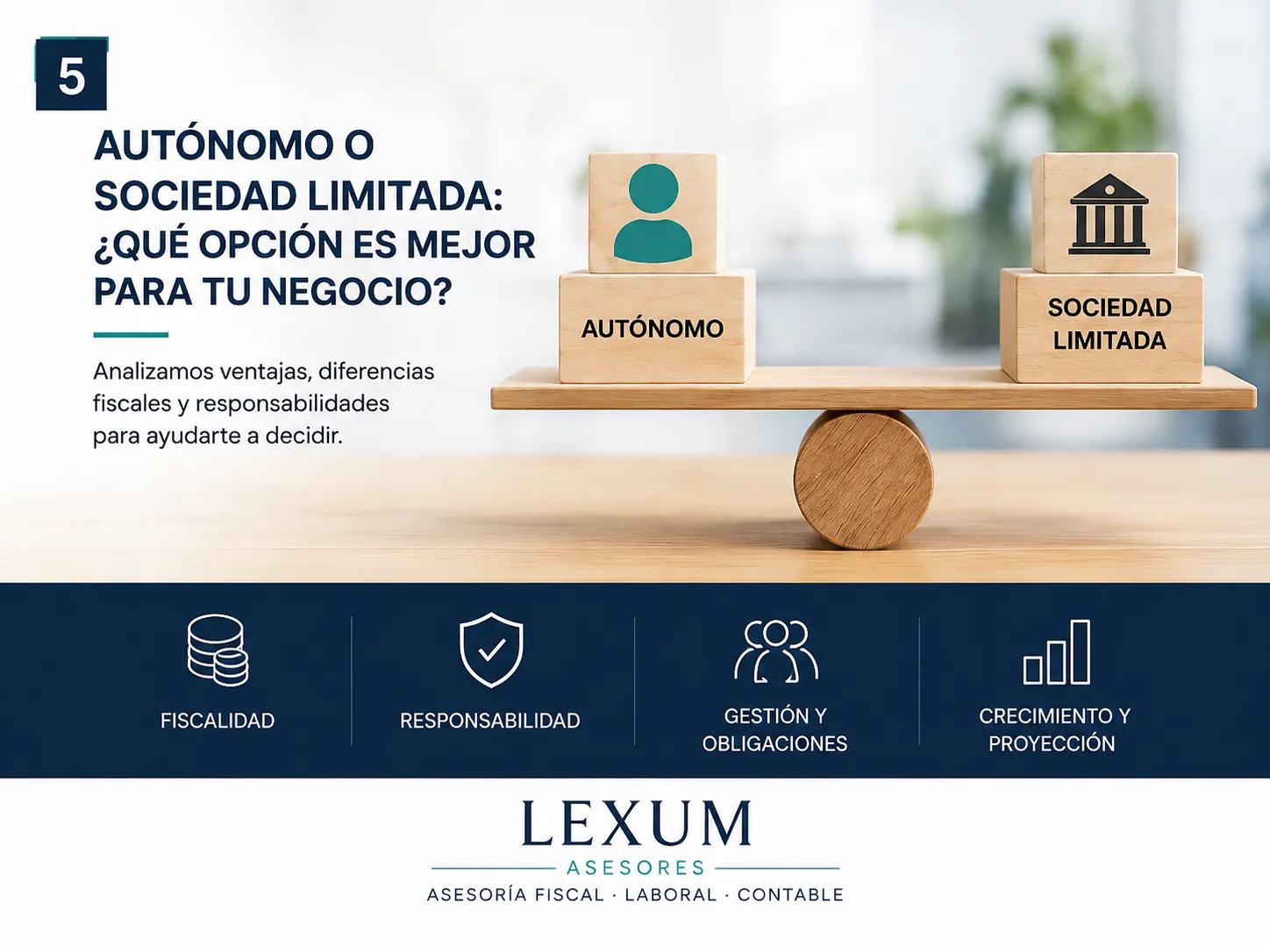
One of the most common questions when starting or growing a business is whether it is better to work as an autónomo (a self-employed worker registered with Spanish social security) or to set up a sociedad limitada (SL, a Spanish limited company).
There is no answer that suits everyone. The choice depends on the expected profit, the risk involved in the activity, the investment needed, the number of partners and how the money will be taken out of the business.
Advantages of working as an autónomo
Registering as an autónomo is usually simpler and lets you start an activity without forming a company.
It may be the right choice when:
- The activity is just starting.
- The initial investment is small.
- There is little business risk.
- There are no other partners.
- The administrative structure is simple.
- Profits are still moderate.
An autónomo is generally taxed under IRPF (Spanish income tax) on the income from their activity. In addition, their Seguridad Social contributions are linked to their net income.
In 2026 there are different income brackets and contribution bases. An autónomo can change their contribution base up to six times a year to match the expected trend in their income.
Advantages of setting up a sociedad limitada
A sociedad limitada has its own legal personality. It may be advisable when:
- Several partners are involved.
- Significant investments are made.
- The activity creates risks towards clients or suppliers.
- You plan to hire staff and grow the structure.
- You want a more established business image.
- Profits will be reinvested.
- You need access to certain agreements or sources of finance.
However, limited liability does not automatically protect the director in every situation. Poor management, failure to meet obligations or certain personal guarantees can lead to additional liability.
Tax differences
A company pays Corporate Income Tax (Impuesto sobre Sociedades), while an autónomo pays IRPF.
This does not mean that a company always pays less tax. When a partner takes money out through a salary, invoices or dividends, there may also be tax and Seguridad Social consequences.
In 2026, the general Corporate Income Tax rate is 25%. Micro-enterprises with a turnover below one million euros pay 19% on the first €50,000 of taxable income and 21% on the rest. Small companies are taxed at a transitional rate of 23%, while certain newly created companies can apply 15% if they meet the requirements.
These percentages should not be looked at in isolation: you also need to work out the partner's personal taxation and the way they receive their income.
More obligations for a company
Setting up a company means more administrative obligations:
- Accounts kept under the Plan General Contable (the Spanish chart of accounts).
- Company books.
- Annual accounts.
- Corporate Income Tax.
- Agreements and documents between partners.
- Control of transactions between the company and its partners.
- Filing documents with the Registro Mercantil (Companies Register).
The director's pay and the partners' Seguridad Social status also need to be properly worked out.
Weigh it up before deciding
It is not advisable to set up a company just because your turnover has gone above a certain figure. What matters is to analyse the real profit, the risks, the expected growth and the business owner's personal needs.
At Lexum Asesores we compare both options and calculate their tax, employment and accounting consequences.
Contact our advisers for the self-employed and companies in Torrevieja and choose the structure that best suits your business.